PCO SPORTS CONCUSSION POLICY & ACKNOWLEDGEMENT INFORMATION
Policy Purpose Statement:
Putnam City Sports recognizes that concussions, a type of traumatic brain injury (TBI), are serious injuries with negative outcomes that can affect an individual physically, emotionally, behaviorally, and/or cognitively, with the potential for long-term impacts on brain development. While concussions have many causes, these brain injuries are commonly sustained by youth participating in athletics or other recreational activities. The purpose of this policy is to maximize safety with respect to sports and recreation related concussions by educating staff, team and game officials, athletes, and parents/guardians about concussions; providing guidance on how to prevent and manage concussions; and supporting youth returning to activities after a concussion, in accordance with Oklahoma state law (70 O.S. § 24-155). This policy will be reviewed on an annual basis. The participating program's Head Coach will be responsible for reviewing requirements of state law against this concussion policy and for seeking any technical assistance needed for policy review and revision. The participating program's Head Coach will be responsible for implementation of this policy.
Click here for a printable copy of PCO Concussion Protocol Policy & Acknowledgement
PCO YOUTH SPORTS POLICY
All head coaches, assistant coaches, and officials associated with PCO Sports shall comply with the provisions of SB-1164 passed by the Oklahoma legislature in 2016.
Said provisions shall be:
1. On an annual basis, game officials and team officials shall undergo concussion training provided by the CDC, the NFHS or a comparable program or resource. A record of completion of the training course shall be readily available upon request.
2. If any game official or team official responsible for the care and safety of an athlete in an athletic event becomes aware or suspects an athlete is exhibiting signs, symptoms or behaviors consistent with having sustained a concussion or head injury, he/she shall remove the athlete from the practice or competition.
3. If an athlete is removed from practice or competition as provided in paragraph 2 the athlete shall not, on the same day the athlete is removed, be permitted to return to that practice or competition or participate in any other practice or competition, unless deemed eligible pursuant to the provisions of paragraph 4.
4. An athlete who has been removed from participation as provided in paragraph 2 shall not participate until the athlete is evaluated by a licensed health care provider trained in the evaluation and management of concussion and receives written clearance to return to participation from that health care provider. The health care provider may be a volunteer. A health care provider, game official or team official, whether volunteer or employee, shall not be liable for civil damages for injury, death or loss to person or property allegedly arising from any act or omission in providing services or performing duties unless the acts or omissions constituting gross negligence or willful or wanton misconduct.
Putnam City Optimist Sports has established the following minimum penalties for a violation of paragraph 2 of this policy:
----First violation; additional concussion recognition and management education as predetermined by the governing body (PCO Sports)
----Second violation; up to an immediate suspension of all coaching privileges within any/all PCO Sports programs for the remainder of said season
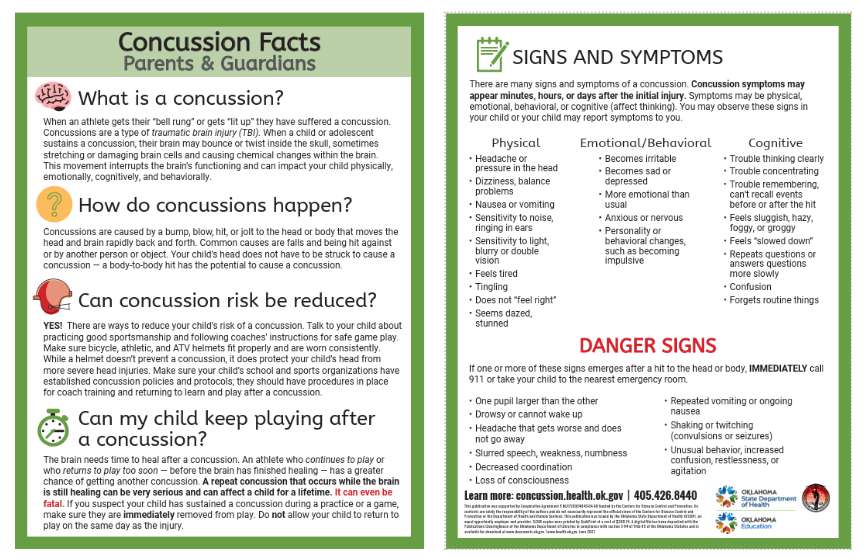
SIGNS OF CONCUSSION AND THINGS FOR COACHES, OFFICIALS AND PARENTS
TO LOOK FOR
● Physical
● Nausea and/or repeated vomiting
● Irregular or labored breathing
● Fever is over 100 degrees Fahrenheit
● Blood or clear fluid draining from nose or ears
● Loss of consciousness/unconsciousness
● New or increased neck pain or stiffness
● Weakness/loss of muscle strength in one or both sides of the body
● Convulsions/seizures
● Headaches or headaches that get worse with emotional stress or physical activity
● Unusual drowsiness, trouble sleeping, or difficulty waking up
● Unsteadiness, lack of coordination or balance, or trouble walking
● Persistent dizziness, lightheadedness
● Trouble swallowing or speaking
● Fatigue, tire easily
● Thinking
● Mental confusion (can't remember, abnormal conversation, etc.)
● Unable to tell what day it is, where they are, or what happened to them
● Reacts, speaks, and thinks slowly
● Problems with short or long term memory, attention, concentration
● Difficulty planning, organizing and carrying out daily tasks, or solving problems
● Trouble understanding what is said, read, or communicated
● Difficulty with reading, spelling, calculations, or writing
● Trouble making decisions, poor judgment
● Not aware of physical, thinking, or behavioral problems
● Sensory
● Changes in taste, smell, touch
● Ringing in the ears, hearing loss
● Increased sensitivity to sounds, lights, distractions
● Blurred, double, or loss of vision
● Trouble seeing clearly, walking, or using arms
● Unequal pupils-one large, one small pupil (may occur after serious physical or
thinking signs become apparent)
● Behavior
● Change in behavior, personality, or self-image
● Trouble sleeping/insomnia
● Needing to sleep long periods
● Lack of initiative or motivation
● Irritable, anxious, overreacts to situations or other emotional change
● Inappropriate behavior, impulsivity
● Lack of interest, motivation, over dependency
● Difficulty adjusting to home, school, work
● Mood swings, depression
● Sexual inhibition/disinhibition
● Increased risk of substance abuse
● Children
● Young children are at high risk of injury but the majority of injuries are not
serious.
● Signs include:
● High pitched crying in infants
● Fussiness or irritability
● Won't nurse or eat
● Changes in behavior that are not developmentally related
● Change in way they play and relate
● Develops problems with words or sentences
● Listless, tires easily
● Loss of balance, unsteady walking
● Older Children/Adolescents
● Reduced stamina
● Reduced ability to adapt
● Subtle or major personality change
● Diminished ability to concentrate, process information and remember/recall in
school
● Difficulty with abstract thinking
● New learning a challenge; knowledge prior to injury more easily retained
● Academic/social difficulties